Box Builder
Design a sealed or ported enclosure for one to four subwoofers. Explore 3D views and panel cuts.
Open Box Builder →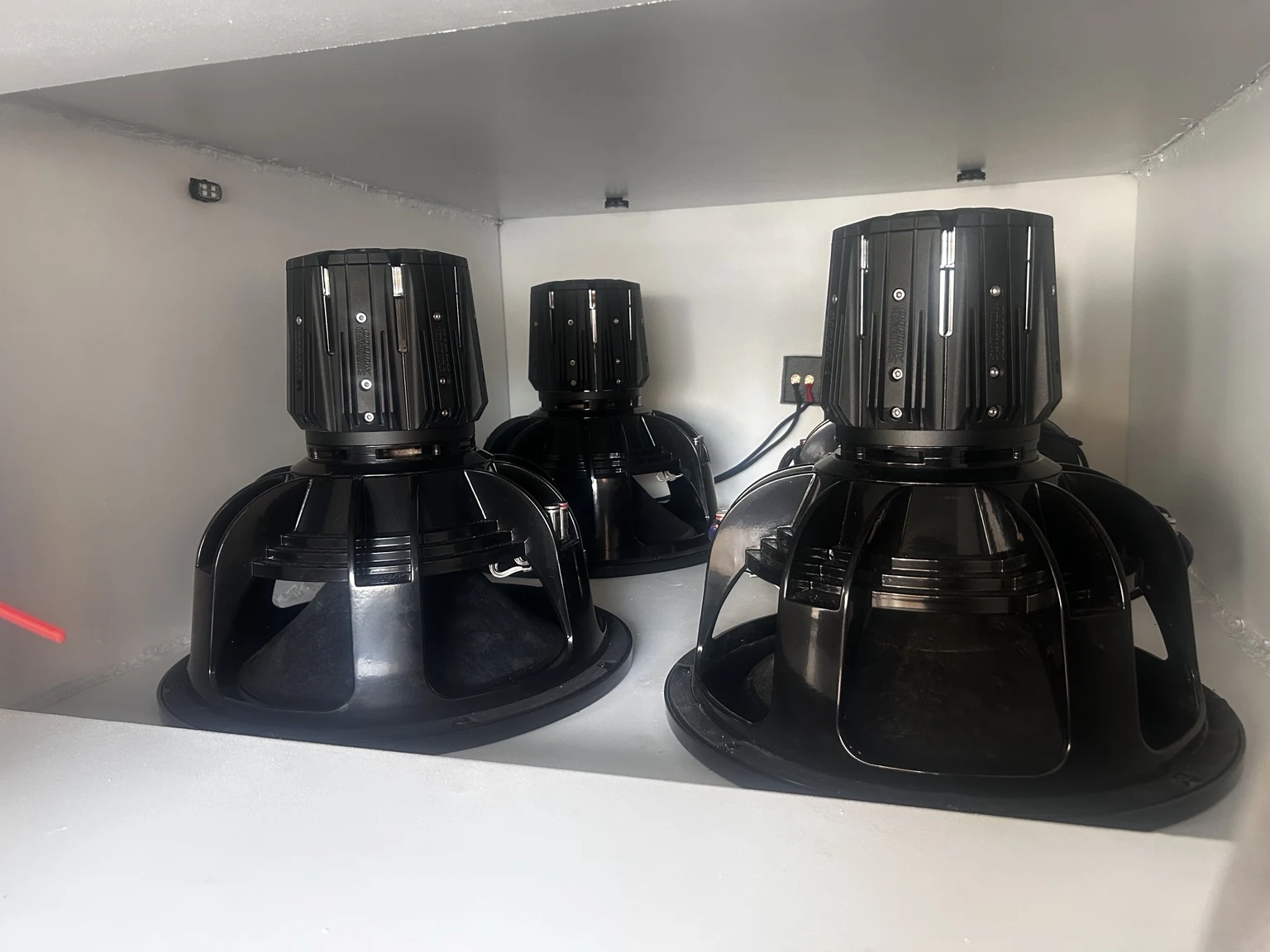
Different subs. Different amps. Different setups. That's part of what makes car audio fun.
We shouldn't have to pay someone else every time we want to try something new. BHN Box Builder gives enthusiasts more freedom to experiment and design their own builds.
Plan your enclosure, work out your wiring, and learn at your own pace.
Design a sealed or ported enclosure for one to four subwoofers. Explore 3D views and panel cuts.
Open Box Builder →Choose your voice coils and final load, then follow the connections.
Explore Wiring →Car audio explained, one term at a time. Pick a letter from A to Z.
Browse A–Z →Explore tools, job guides, and starter kits.
A system built around headroom, efficient output, and room to grow. Here’s the thinking behind my personal build.
Two JP93 bass amplifiers provide headroom to accommodate impedance rise without relying on extremely low wiring loads. The aim is the output I want without pushing the demo system to its limit.
Dual high-output alternators support separate voltage systems: higher voltage for the bass amplifiers and lower voltage for the midrange and highs.
Each door is planned around six PRV 6½-inch midranges and two 8-inch midbass speakers. The goal is loud, clear, full sound with efficient use of amplifier power—and more power available when needed.
The fourth-order enclosure targets about 36 Hz in its ported chamber. Musical low-end is the priority. Its sealed chamber contributes to cone control alongside appropriate filtering and power management.
Power-cable runs already extend to the rear, with provision to add more runs as the system grows. The wiring layout is designed to be expandable rather than locking the build into its first configuration.
Personal build progress, from the workbench to the van.
Explore standard sealed, ported, and basic wall design services. Advanced bandpass designs are not offered through checkout.
Pick a letter. Tap a term for a clear explanation.
Electrical potential difference that drives current through a circuit. An amplifier's available output can change with its supply voltage.
Link to this termFlow of electrical charge, measured in amperes. Powerful amplifiers can demand substantial current from the charging system.
Link to this termOpposition to current flow. Resistance at a loose connection can cause voltage loss and concentrated heat.
Link to this termRate of energy transfer, measured in watts. For DC input, power equals voltage multiplied by current.
At 14 volts and 100 amps, DC input is 1,400 watts. Speaker output is lower because the amplifier is not 100% efficient.
Total work available over time. Battery energy is commonly expressed in watt-hours.
Link to this termThe relationship V = I × R. Greater current through the same wiring resistance causes greater voltage drop.
A 0.01-ohm connection carrying 100 amps loses 1 volt: 100 × 0.01 = 1.
Heat produced by current flowing through resistance. Heating follows I²R: doubling current creates four times the heat at the same resistance.
Link to this termCurrent flowing in one direction. The battery supplies DC power to the amplifier.
Link to this termCurrent reversing direction. An amplifier's speaker signal moves the cone back and forth.
Link to this termHow readily a material carries current. Copper and aluminum require different conductor areas for comparable resistance.
Link to this termComponents connected along one current path. Series-connected speaker impedances add together.
Two nominal 4-ohm coils in series produce a nominal 8-ohm load.
Multiple current paths across the same terminals. Parallel-connected speakers reduce the combined impedance.
Two nominal 4-ohm coils in parallel produce a nominal 2-ohm load.
Voltage lost across wiring or connections while current flows. Test under load to locate restrictive power or ground paths.
If the battery measures 14.2 V while the amplifier terminals measure 13.2 V at the same moment under load, the supply and return paths together are losing about 1.0 V.
Current consumed at a particular moment. Music, volume, load impedance, and amplifier efficiency influence it.
Link to this termEquipment consuming power. Audio shares the charging system with lights, fans, computers, and other vehicle equipment.
Link to this termAn electrical path between two points. A continuity beep alone does not prove a connection can carry high current properly.
Link to this termAn unintended low-resistance connection. A positive cable touching grounded metal can cause extremely high current.
Link to this termA broken electrical path. A disconnected remote wire can prevent an amplifier from turning on.
Link to this termResistance where conductive surfaces meet. Corrosion, poor crimps, and loose hardware can increase it.
Link to this termResistance inside a component or battery. Higher battery resistance generally increases voltage sag under load.
Link to this termAbility to store electrical charge. A capacitor supports brief demands but does not replace adequate continuous charging capacity.
Link to this termAn electrical property associated with magnetic fields that opposes changes in current. Voice-coil inductance affects speaker behavior.
Link to this termFrequency-dependent opposition caused by capacitance or inductance. Speakers therefore do not behave like simple resistors.
Link to this termTotal opposition to AC, including resistance and reactance. A nominal 2-ohm speaker is not exactly 2 ohms at every frequency.
Link to this termEngine-driven equipment supplying electrical power and charging the battery while the engine runs.
Link to this termOutput capability under stated conditions. That current may not be available at every engine speed.
Link to this termCurrent available at idle under specified conditions. Important when playing a system while parked.
Link to this termAn alternator designed for increased electrical output. Idle performance, heat, and vehicle compatibility still matter.
Link to this termA control adjusting alternator operation to maintain the intended charging voltage.
Link to this termA separate control used with compatible alternators. Its settings must suit the batteries and vehicle electronics.
Link to this termVehicle-controlled charging that varies with operating conditions. Changing voltage is not automatically a charging fault.
Link to this termRelationship between engine and alternator pulley sizes, determining alternator speed relative to engine speed.
Link to this termLoss of grip between belt and pulley. It can reduce charging output and produce noise or heat.
Link to this termTarget charging voltage. Appropriate settings depend on battery chemistry, temperature, and equipment requirements.
Link to this termAC variation remaining on the DC supply. Excessive ripple can indicate charging-system problems.
Link to this termTwo alternators in one installation. Mounting, regulation, wiring, and belt loading need coordinated design.
Link to this termA battery designed mainly for short, high-current bursts used to start an engine.
Link to this termA battery designed for repeated discharge and recharge. Required discharge current still determines suitability.
Link to this termA standardized measure of time supplying a specified current before reaching a defined cutoff voltage.
Link to this termCharge capacity under stated conditions. A 100 Ah rating does not establish unlimited high-current capability.
Link to this termStored energy expressed using voltage and amp-hours. Useful when comparing different-voltage battery banks.
Link to this termA standardized cold-weather starting rating. It does not directly measure sustained support for an audio system.
Link to this termHow full a battery is relative to its available capacity.
Link to this termBattery condition compared with original performance, including capacity loss and resistance changes.
Link to this termPercentage of capacity removed. Using 30% of a full battery's capacity is approximately 30% DOD.
Link to this termDischarge-and-charge cycles endured under specified conditions before a defined degradation threshold.
Link to this termInternal opposition that contributes to heating and voltage loss under heavy demand.
Link to this termDrop in terminal voltage under load. Charge level, condition, temperature, and demand influence it.
Link to this termBattery construction using liquid electrolyte. Maintenance, ventilation, and mounting requirements matter.
Link to this termAbsorbent glass mat lead-acid construction holding electrolyte in glass mats. Follow the specific battery's charging requirements.
Link to this termA lead-acid battery with gelled electrolyte. Charging requirements differ from some other lead-acid designs.
Link to this termLithium iron phosphate chemistry. Charging voltage and temperature limits must match the particular battery system.
Link to this termLithium titanate battery technology, often used for high-current applications. Cell voltage differs from other lithium technologies.
Link to this termLithium chemistry using nickel, manganese, and cobalt in the cathode. Voltage and protection requirements differ from LTO and LiFePO₄.
Link to this termElectronics monitoring and protecting a battery within specified capabilities, potentially including voltage, temperature, and current limits.
Link to this termBringing cell charge levels closer together so one cell is less likely to reach a limit before others.
Link to this termArrangement of series and parallel cells. Series increases voltage; parallel increases capacity and potential current capability.
Link to this termCurrent expressed relative to capacity. For a 100 Ah battery, 1C equals 100 amps.
A 50 Ah battery at a 2C discharge rate supplies 100 amps. Whether it can do so depends on its specified limits.
Charging current a battery can accept under particular conditions. It varies with chemistry, temperature, and charge level.
Link to this termProtection blocking or limiting charging below permitted temperatures. Limits depend on the specific battery.
Link to this termA conductor-size system. Smaller gauge numbers generally indicate thicker conductors.
Link to this termActual conductor area, often measured in square millimeters. Insulation thickness does not establish conductor size.
Link to this termOxygen-free copper wire. Actual conductor area and construction still matter when choosing cable.
Link to this termCopper-clad aluminum wire. It has greater resistance than an equal-area copper conductor.
Link to this termCopper coated with tin to improve corrosion resistance, commonly used in marine or moisture-exposed installations.
Link to this termFlexible cable intended for welding service. Check conductor material, insulation, environment rating, and terminal compatibility for automotive use.
Link to this termCurrent a conductor can carry under specified conditions without exceeding its permitted temperature.
Link to this termDistance covered by a cable. Greater length increases resistance for the same conductor material and area.
Link to this termTemperature limit of wire insulation. Routing near hot equipment affects cable selection.
Link to this termNumber of strands in a conductor. More strands can improve flexibility without necessarily increasing current capacity.
Link to this termCable supplying battery-positive power. Routing and circuit protection are central to its installation.
Link to this termCable carrying return current. Resistance and current capacity matter just as they do on the positive path.
Link to this termA device opening a circuit under excessive current according to its operating characteristics and ratings.
Link to this termSpecified fuse current rating. Coordinate it with conductor protection and equipment requirements.
Link to this termHow quickly a fuse operates at different current levels. A fuse does not necessarily open instantly at its printed rating.
Link to this termMaximum fault current a protective device can safely interrupt. Especially relevant for powerful battery banks.
Link to this termA bolt-down fuse format commonly used for high-current circuits. Actual product ratings determine suitability.
Link to this termCompact bolt-down fuse formats. Match the exact fuse to its compatible holder and application.
Link to this termA bolt-down high-current fuse format. Check voltage, interrupt, and time-current ratings.
Link to this termA plug-in automotive fuse format commonly used for lower-current circuits.
Link to this termA device interrupting excessive current that may be reset. Verify suitability for the automotive DC circuit.
Link to this termProtection near a battery-positive source connection for the cable leaving that source.
Link to this termProtection for an individual downstream cable, such as a smaller amplifier feed.
Link to this termResistance at the holder and connections. Poor contact can cause heating despite a correctly selected fuse.
Link to this termA connection using the vehicle's metal structure as part of the return path.
Link to this termA connection bonding the engine to the battery-negative and vehicle return system.
Link to this termReturn connection at the battery. Loose or corroded hardware can affect multiple vehicle systems.
Link to this termConnecting conductive structures to provide an effective shared return path.
Link to this termMultiple ground paths that can allow unwanted currents and introduce signal noise.
Link to this termVoltage difference between supposedly equivalent ground points, potentially interfering with signal transfer.
Link to this termA junction combining ground cables. The upstream path must carry their combined demand.
Link to this termUpgrading alternator-positive, battery-negative-to-chassis, and engine-to-chassis wiring. It reduces wiring restrictions without increasing alternator output.
Larger cables may reduce voltage loss, but an alternator already at its output limit still cannot provide additional continuous current.
An expanded power/ground upgrade. The name is informal; specify which fourth connection is included.
Link to this termAn original bonding connection. It may serve vehicle functions beyond audio.
Link to this termMaking a clean, secure conductive connection using suitable hardware and corrosion protection.
Link to this termMeasuring voltage across the return path under load to locate losses that an unloaded check can miss.
Link to this termA cable termination with a closed hole that attaches to a bolt or stud.
Link to this termA sleeve crimped over strands for compatible terminals, containing strands and supporting consistent contact.
Link to this termA connector joining two wire ends. Its conductor range and crimp requirements must match the wires.
Link to this termA mechanically compressed electrical joint. Matched tooling and terminals are essential.
Link to this termA connection made with solder. Mechanical support matters in vibrating or moving installations.
Link to this termInsulating tubing contracting when heated. Adhesive-lined versions can help seal out moisture.
Link to this termA conductive bar distributing power or ground across multiple connections.
Link to this termA junction splitting a larger feed into branches, sometimes with integrated fuses.
Link to this termConnection hardware at a battery post or stud. Contact quality affects the connected circuit.
Link to this termAn adapter connecting large cable to a smaller terminal. It does not remove the smaller terminal's limitations.
Link to this termSpecified tightening force for hardware. Too little or too much can harm the connection.
Link to this termSupport keeping cable movement from stressing a termination.
Link to this termAn electrically controlled switch operating one circuit through a separate control circuit.
Link to this termThe electromagnetic part that operates relay contacts when energized.
Link to this termA relay contact that stays open while the relay is not energized.
Link to this termA relay contact that stays connected while the relay is not energized.
Link to this termA control signal telling equipment to switch on, separate from the main amplifier power feed.
Link to this termA circuit powered in specified accessory operating modes.
Link to this termPower available in designated ignition states. Exact behavior depends on the vehicle circuit.
Link to this termA device separating battery circuits under particular conditions to manage charging and discharge paths.
Link to this termA relay joining or separating battery banks according to its charging-detection logic.
Link to this termA regulated charger transferring energy between DC systems with a defined charging profile.
Link to this termAn electrical energy-storage component offering brief support determined by capacitance, voltage, and resistance.
Link to this termA group of high-capacitance cells. Cell voltage limits and balancing matter when cells are connected in series.
Link to this termAn amplifier with one output channel, commonly used for subwoofers.
Link to this termAn amplifier providing two channels for stereo speakers or supported bridged operation.
Link to this termAn amplifier providing four channels, often for front/rear speakers or an active front stage.
Link to this termAn amplifier containing multiple channels, potentially combining full-range and subwoofer outputs.
Link to this termAn output-stage design whose active devices conduct throughout the signal cycle, usually with relatively low efficiency.
Link to this termAn output-stage design improving efficiency over Class A while addressing crossover distortion.
Link to this termAn amplifier using a switching output stage. The amplifier class alone does not determine sound quality.
A well-designed Class D amplifier can deliver clean full-range audio. Switching operation does not mean the music signal is inherently digital.
The share of electrical input delivered as output power. Much of the remainder becomes heat.
Link to this termCircuitry converting vehicle power to the internal supply required by the amplifier.
Link to this termCircuitry delivering the amplified electrical signal to the speaker.
Link to this termLowest permitted load for a specified configuration. Going below it can exceed amplifier limits.
Link to this termOperation limited or stopped because equipment detects a fault, excessive temperature, or unsuitable voltage.
Link to this termOutput measured under sustained test conditions. Compare voltage, load, distortion, and channel count along with watts.
Link to this termA maximum or short-duration claim whose meaning depends on the stated test method.
Link to this termEffective value of an AC waveform. For a resistive load, power is V²/R.
Link to this termSupply voltage used for a published output measurement. Different test voltages affect comparisons.
Compare two power ratings at the same supply voltage and load before concluding which amplifier provides more output.
Harmonic content introduced relative to the intended signal.
Link to this termA measurement combining harmonic distortion and noise.
Link to this termRelationship between a specified signal level and background noise under stated conditions.
Link to this termRatio relating load impedance to amplifier output impedance. Wiring and speaker behavior also affect the installed system.
Link to this termCombining compatible channels to drive a load with a greater voltage difference.
Link to this termLinking specifically compatible amplifiers to drive a load together using the manufacturer's configuration.
Link to this termAdjustment matching the amplifier to source output level. Correct settings help avoid input or output clipping.
Changing the head unit or line-output converter can require resetting gain because the input signal voltage has changed.
How well one channel's signal is isolated from another.
Link to this termA driver intended for low frequencies. Driver, enclosure, power, and placement determine installed performance.
Link to this termA speaker covering the region between deep bass and midrange, adding impact and body to instruments.
Link to this termA speaker covering much of the vocal and instrument range.
Link to this termA speaker intended for high frequencies.
Link to this termAn arrangement placing multiple frequency-producing elements on a shared axis.
Link to this termSeparate drivers, typically woofers and tweeters, with a crossover arrangement.
Link to this termA driver coupling diaphragm output through a small exit, generally into a horn or waveguide.
Link to this termAn acoustic structure controlling radiation and improving coupling between a driver and surrounding air.
Link to this termThe moving diaphragm radiating sound in a conventional cone speaker.
Link to this termThe flexible connection between the cone's outer edge and the basket.
Link to this termInner suspension supporting and centering the moving assembly.
Link to this termWire winding whose interaction with the magnetic field creates force on the moving assembly.
Link to this termA driver with one coil circuit for connection.
Link to this termA driver with two coils permitting multiple wiring configurations.
Link to this termStructural frame supporting the driver's fixed and moving parts.
Link to this termComponents creating and directing the magnetic field around the voice coil.
Link to this termA magnetic-circuit component helping shape the field inside the motor.
Link to this termA magnetic-circuit component forming part of the voice-coil gap.
Link to this termStructure supporting the coil winding and connecting it to the moving assembly.
Link to this termMagnetic flux density multiplied by active conductor length, describing motor force per unit current.
Link to this termElectrical input a driver tolerates thermally under specified conditions.
Link to this termInput limited by travel or mechanical stress. It varies with frequency and enclosure.
Link to this termCone travel within a defined range of acceptable suspension and motor behavior.
Link to this termA manufacturer-defined physical travel or damage limit, different from linear excursion.
Link to this termFree-air resonant frequency. It is an enclosure-model input, not a universal port-tuning target.
Link to this termTotal driver Q at resonance, combining electrical and mechanical effects.
Link to this termElectrical Q at resonance, describing the contribution of electrical damping.
Link to this termMechanical Q at resonance, describing damping from mechanical losses.
Link to this termAir volume with the same compliance as the suspension. It is not the recommended enclosure volume.
Link to this termVoice-coil DC resistance, usually different from nominal speaker impedance.
Link to this termVoice-coil inductance measured under specified conditions.
Link to this termEffective radiating area of the diaphragm.
Link to this termRated one-way linear excursion limit. Manufacturers may use different methods to establish it.
Link to this termLinear displacement volume, commonly calculated as Sd × Xmax using consistent units.
Link to this termMoving mass in the driver model, including the relevant air-load contribution.
Link to this termMechanical suspension compliance. Greater compliance means a more easily displaced suspension.
Link to this termAn airtight box whose trapped air adds stiffness to the driver's suspension.
Link to this termA box with a tuned vent contributing output and changing driver behavior around tuning.
Link to this termA driver between sealed and ported chambers, with sound radiating through the port.
Link to this termA bandpass enclosure whose two chambers each vent outside.
Link to this termA bandpass enclosure where one chamber vents into the other and the second vents outside.
Link to this termAn acoustic passage behind the driver whose dimensions and damping shape its response.
Link to this termA transmission line with changing cross-sectional area along its length.
Link to this termA horn with a bent passage to fit a longer acoustic path into a smaller package.
Link to this termA horn coupling a driver to its passage at two locations whose outputs combine.
Link to this termA box using an unpowered diaphragm for resonant behavior similar to a port.
Link to this termAn arrangement separating front and rear sound while providing sufficiently large rear air volume.
Link to this termA design using a resistive acoustic vent to change damping and enclosure behavior.
Link to this termInterior volume before subtracting components and structural displacement.
Link to this termUsable chamber airspace after subtracting relevant driver, port, brace, and other displacement.
A 4.0 ft³ gross interior minus 0.3 ft³ of drivers, 0.5 ft³ of port, and 0.2 ft³ of bracing leaves 3.0 ft³ net.
Interior volume physically occupied by the driver.
Link to this termSpace excluded from the main chamber by the port passage and its construction.
Link to this termVolume occupied by internal bracing, which must be included in net-volume calculations.
Link to this termResonant frequency of a bass-reflex enclosure's chamber-and-vent system.
Link to this termResonance of a driver installed in a sealed enclosure.
Link to this termTotal Q of the driver and sealed enclosure, influencing response shape and damping.
Link to this termUnintended airflow through joints or gaps that can change enclosure behavior.
Link to this termA stationary interference pattern formed by sound reflections between boundaries.
Link to this termMaterials or construction absorbing acoustic energy to control internal resonances.
Link to this termSpring-like behavior of air. Larger enclosed volumes generally add less air stiffness.
Link to this termA rectangular vent often built partly from enclosure walls.
Link to this termA circular vent whose area and effective length contribute to tuning.
Link to this termA vent with shaped ends intended to reduce flow separation and turbulence.
Link to this termA curved wooden port made with closely spaced cuts allowing a panel to bend.
Link to this termCross-sectional airflow opening. It affects velocity and the length required for a given tuning.
An 18-inch-high slot with a 4-inch clear width has 72 square inches of cross-sectional area.
Constructed passage length measured along its path, including bends.
Link to this termAcoustically relevant length, including effects beyond physical port ends.
Link to this termAn adjustment accounting for air movement outside the port openings.
Link to this termAir speed through a vent. High velocity can increase noise and losses.
Link to this termReduced output growth as increasing airflow creates greater losses.
Link to this termAudible turbulence noise from the vent, often noticeable during sustained bass.
Link to this termSpace around an opening. Nearby obstacles can restrict airflow and change acoustic behavior.
Link to this termA dense engineered wood product used for enclosures. Moisture exposure and dust control matter.
Link to this termMulti-ply wood valued for structural properties and exposed-edge appearance. Quality and thickness vary by product.
Link to this termPanel thickness used in structural design and internal-volume calculations.
Link to this termThe panel supporting the mounted speaker.
Link to this termTwo layers forming a thicker, stiffer mounting panel and supporting deeper recesses.
Link to this termA brace with openings supporting panels while allowing airflow through the box.
Link to this termA joint fitting a panel edge into a groove in another panel.
Link to this termA joint using an edge recess to locate and support another panel.
Link to this termA joint where one panel edge meets another panel's face.
Link to this termGlue selected for the materials and conditions. Joint fit and clamping support strength.
Link to this termA smaller hole drilled before a screw to guide it and reduce splitting.
Link to this termA tapered recess allowing a suitable screw head to sit flush or below the surface.
Link to this termA composite enclosure that can follow irregular vehicle contours.
Link to this termThe binding material used with reinforcement in composite construction. Handling requirements depend on the resin system.
Link to this termA material preventing a composite part from bonding to its mold.
Link to this termA guide controlling repeatable cuts such as speaker openings and windows.
Link to this termA router bit using a bearing or guide to match an edge to a reference surface.
Link to this termA stepped opening allowing the mounting flange to sit lower in the baffle.
Link to this termA fitting providing reusable internal threads in wood or another material.
Link to this termA transparent display panel. Thickness, span, mounting, and sealing determine suitability.
Link to this termA transparent material with different impact resistance, stiffness, and scratch behavior from acrylic.
Link to this termA seal between a transparent panel and its mounting surface.
Link to this termA finishing panel concealing hardware, structural surfaces, or gaps.
Link to this termA protective cover shielding the driver while allowing sound transmission.
Link to this termThe audio source and control device supplying signals to the system.
Link to this termA line-level analog output connecting a source to an amplifier or processor.
Link to this termAn amplified speaker signal, sometimes accepted by compatible amplifier or processor inputs.
Link to this termA device converting speaker-level signals for use with line-level inputs.
Link to this termA signal arrangement designed to reject interference common to both signal conductors when properly implemented.
Link to this termAn input responding to the voltage difference between conductors, potentially rejecting shared interference.
Link to this termWireless audio whose behavior depends on devices, codec, and implementation.
Link to this termDigital audio transferred using supported USB device protocols.
Link to this termA device converting digital audio data into an analog electrical signal.
Link to this termDigital audio carried by light through fiber, providing electrical isolation between connected devices.
Link to this termDistortion created when the source exceeds its signal range, before the amplifier receives the signal.
Link to this termAn external level or bass control. Its actual function depends on the amplifier or processor design.
A remote level knob may only reduce output from the gain setting, while a boost knob may increase a particular frequency region. Check its documented function.
The original vehicle amplifier, potentially including processing, filtering, diagnostics, and multiple outputs.
Link to this termFrequency shaping built into the original system for its speakers and installation.
Link to this termFiltering assigning different frequency ranges to original speakers.
Link to this termA filter changing phase while ideally preserving magnitude response.
Link to this termCombining signals, potentially reconstructing broader frequency coverage from separate factory channels.
Link to this termReduction of low-frequency output, sometimes increasing with volume in factory systems.
Link to this termMonitoring an output's electrical load, potentially changing operation when a speaker is disconnected.
Link to this termA resistor presenting a defined load. Resistance and heat dissipation must match the application.
Link to this termAn adapter communicating with vehicle networks to retain or provide supported functions.
Link to this termA vehicle system generating sound to reduce cabin noise. Audio changes can affect its operation.
Link to this termPreserving alerts and notification sounds when modifying original audio equipment.
Link to this termA processor accepting, correcting, combining, and routing existing-system signals.
Link to this termDigital audio processing equipment offering functions such as filters, EQ, delay, and routing.
Link to this termA filter reducing frequencies below its transition region.
Link to this termA filter reducing frequencies above its transition region.
Link to this termA filter passing a selected frequency range while reducing output above and below it.
Link to this termA high-pass filter reducing very low frequencies, often used to limit excessive subwoofer excursion.
Link to this termAttenuation rate beyond a filter's transition region, commonly expressed in decibels per octave.
Link to this termA filter alignment designed for a maximally flat passband magnitude response.
Link to this termA crossover alignment designed for a particular summed response when complementary branches are correctly combined.
Link to this termEQ with adjustable frequency, gain, and bandwidth or Q.
Link to this termEQ using fixed frequency bands with adjustable levels.
Link to this termDelay applied to selected channels to adjust arrival timing at a listening position.
Link to this termProcessing restricting signal level according to configured limits and timing behavior.
Link to this termCycles per second, measured in hertz. A 40 Hz tone completes 40 cycles every second.
Link to this termDistance covered by one wave cycle. Lower frequencies have longer wavelengths.
Link to this termSound pressure expressed logarithmically in decibels relative to a reference pressure.
Link to this termHow system output changes across frequency under specified measurement conditions.
Link to this termLow-frequency reinforcement associated with the vehicle interior and its acoustic boundaries.
Link to this termPosition of a repeating signal within its cycle relative to another signal.
Link to this termElectrical orientation of a connection or signal. Reversing polarity inverts the waveform.
Link to this termReduced output when sound contributions combine destructively because of phase and timing relationships.
Link to this termPerceived location and spread of performers or instruments.
Link to this termHow precisely a system places perceived sound sources within the soundstage.
Link to this termA treatment combining a damping layer and constraining layer to reduce panel vibration.
Link to this termA heavy flexible barrier used in suitable sound-isolation assemblies. It serves a different function from panel damping.
Link to this termA tool measuring voltage, resistance, and other quantities within its specified capabilities.
Link to this termA tool showing voltage over time, useful for observing waveforms and clipping.
Link to this termA tool measuring conductor current without opening the circuit, within its AC or DC capabilities.
Link to this termA microphone with known measurement characteristics used to assess acoustic output.
Link to this termMeasurement of impedance across frequency to investigate driver and enclosure behavior.
Link to this termWaveform distortion caused when an amplifier cannot reproduce the requested signal within its available limits.
Link to this termReduced output as heating changes driver behavior, commonly through increasing voice-coil resistance.
Link to this termReduced acoustic loading below a vented enclosure's tuning region, allowing greater cone excursion.
Playing substantial bass below a ported box’s tuning can demand more cone travel even when the amplifier has not reached its maximum output.
Noise often changing with engine speed. Signal, grounding, wiring, and charging faults can contribute.
Link to this termCurrent consumed while a vehicle is in its intended off or sleep state.
An amplifier that remains on after the vehicle sleeps can contribute to overnight battery discharge.
A brief tone played for high measured output. Frequency and duration depend on the event and system.
Link to this termSensor position and orientation. Consistent placement is essential for comparisons and must follow applicable competition rules.
Link to this termNo terms found. Try another letter or search.
Your space. Your sound. A clear path from design to the first cut.
Drag to orbit · arrow keys to rotate · dimensions update live
Square butt joints. Double baffle stays inside the selected outside dimensions; internal depth and port length account for both layers. Front/back panels cap the frame; top/bottom span its full width, and sides fit between them. Dimensions exclude saw kerf. Check driver basket clearance, mounting depth, material, and your vehicle before cutting. Slot ports fold once when needed; kerf folds use a curved channel and matching corner filler. No driver-response or port-air-speed simulation is provided.
Choose your subs and coil impedance. Select a final load, then follow each connection.
Swipe or scroll the diagram to see every sub and terminal.
Disconnect amplifier power before wiring. Check every terminal and the amplifier’s manual before turning it on. Calculated values are nominal AC impedance; a multimeter measures DC resistance, which is normally lower. The terminal blocks are enlarged on each sub for clarity. Physical terminal positions vary by model; identify the actual coil and polarity labels on your subwoofer.
Coming soon.
Available on Microsoft Store
Buy & Download on Microsoft Store ↗
From basic boxes to advanced enclosure designs, build your way with powerful design tools, flexible customization, and an extensive range of extra features. Bring your ideas to life with more options and more control over every build.
Coming Soon
Plan your system with confidence. Bring enclosure design, subwoofer wiring, electrical planning, and amplifier setup together in one mobile app—built from hands-on car-audio experience.
More design options. More control over your build. One-time purchase. No subscription.

My interest in car audio started before I was old enough to drive. It was something my family enjoyed—my brothers always had cars, speakers, amplifiers, and old stereo equipment around. I started by experimenting with equipment they were no longer using, and that gradually developed into an interest in electronics and car audio.
By the time I was getting my first car, the stereo system was already part of the plan. I learned installations hands-on, working on older vehicles and helping with other people's systems before wiring guides and plug-and-play solutions were something I knew about.
I also learned through mistakes. I've dealt with inadequate electrical systems, damaged alternators, amplifier failures, clipping, and blown equipment. Those experiences pushed me to understand not just how to install equipment, but why systems work—or fail—the way they do.
Over the years, I continued building systems and expanding my knowledge. I also realized that even with the amount of car-audio information available today, there is still a need for practical information written for the person actually building and using the system.
I began sharing what I had learned through videos. As those videos reached more people, I started receiving questions and requests for help from others building their own systems.
BASSHEAD NEMO LLC grew naturally from that. What started as a family interest became years of hands-on experience, learning, building, and helping others. I'm now turning that experience into a career and building resources designed to make useful car-audio information easier to understand and apply.
And this is only the beginning.
Business inquiries: [email protected]
New to car audio? Get practical explanations, a plan for your next step, and paid support that respects both your project and our time.
Affordable written advice for a single car-audio topic. No design files, detailed calculations, phone calls, or live sessions included.
All support is by email—no phone calls, live sessions, or instant replies. For budget consultations, one exchange means one customer question and one response; the allowance is limited to one topic and does not include design files or detailed calculations. A round means one grouped email of questions and photos, followed by one response from us. We follow up by email about your next steps and timing. Build support runs for 30 days from the agreed start date; unused rounds expire. New projects, extra rounds, and extensions need a separate agreed price. Nothing renews automatically.
Purchased a Basshead Nemo service? Share your experience. Reviews are published after moderation.
Loading reviews…